

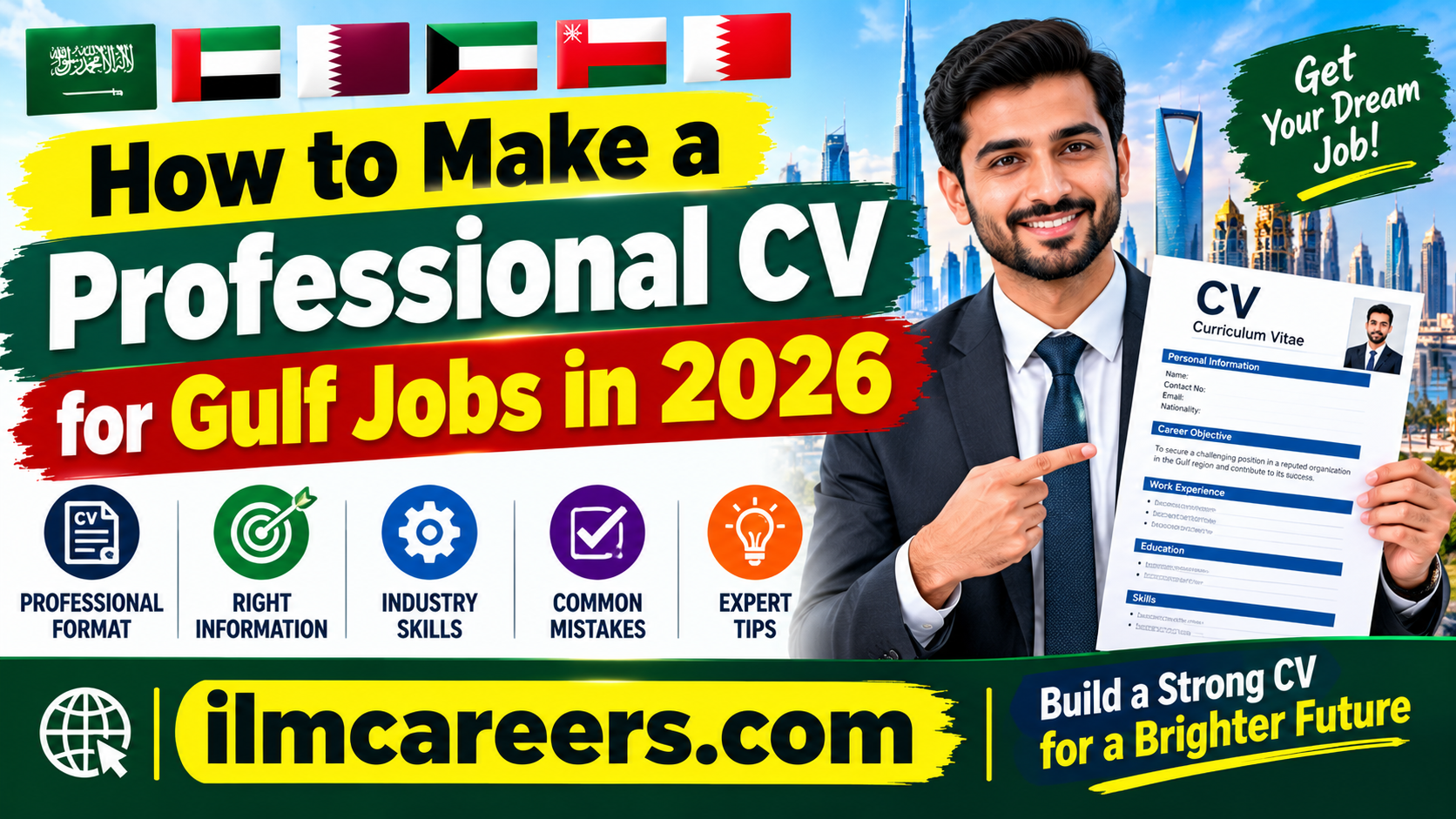
Finding a job in Gulf countries such as Saudi Arabia, the United Arab Emirates (UAE), Qatar, Oman, Kuwait, and Bahrain can be a great opportunity for Pakistani job seekers. However, before applying for overseas employment, it is important to prepare a professional CV that highlights your skills, qualifications, and work experience.
A well-written CV helps employers understand your professional background and determine whether you are suitable for a particular position. Whether you are applying for a technical job, construction position, driving job, office role, or engineering vacancy, your CV should be clear, accurate, and relevant to the job.
In this guide, you will learn how to make a professional CV for Gulf jobs, what information to include, common mistakes to avoid, and how to improve your chances of getting shortlisted.
1. Choose a Professional CV Format
The first step is selecting a simple and professional CV format. Most employers need to review applications quickly, so your CV should be easy to read and understand.
Your CV should include the following sections:
- Full name and contact information
- Professional summary
- Work experience
- Educational qualifications
- Technical and professional skills
- Certifications and training
- Languages
- Relevant additional information
For most experienced workers, a reverse-chronological CV is a practical choice. This format lists your most recent job first, followed by previous positions.
Keep your CV organized with clear headings, consistent formatting, and readable fonts.
2. Write a Strong Professional Summary
A professional summary is a short introduction at the beginning of your CV. It should explain your occupation, experience, major skills, and career strengths.
Avoid writing long personal stories or including information unrelated to the job.
Example for an Electrician:
“Experienced Electrician with 5 years of experience in electrical installation, maintenance, troubleshooting, and electrical safety procedures. Skilled in reading electrical drawings, inspecting equipment, and performing preventive maintenance. Seeking an opportunity to contribute technical expertise to a reputable organization in the Gulf region.”
Example for a Construction Worker:
“Hardworking construction worker with experience in site preparation, material handling, basic construction activities, and workplace safety. Capable of working in a team and following site instructions. Seeking a suitable construction position in the Gulf region.”
Customize your summary according to your actual experience and the position you want to apply for.
3. Highlight Relevant Work Experience
Work experience is one of the most important sections of a professional CV, particularly for skilled and technical positions.
For each previous job, mention:
- Job title
- Company name
- Country or city
- Employment period
- Main responsibilities
- Relevant achievements
Use bullet points to describe your responsibilities clearly.
For example:
Job Title: Electrical Technician
Experience: 2022–2025
Responsibilities:
- Installed and maintained electrical equipment.
- Inspected electrical systems and identified faults.
- Performed preventive maintenance according to safety procedures.
- Assisted with troubleshooting and equipment repairs.
Only include responsibilities that accurately reflect your experience. Never invent employment history, qualifications, or technical skills to make your CV appear stronger.
If you are a fresher, highlight internships, practical training, apprenticeships, academic projects, and relevant skills instead.
4. Include Your Educational Qualifications
List your education and technical qualifications in a clear format.
For example:
Diploma of Associate Engineering (Electrical)
Institution: [Your Institute Name]
Year of Completion: [Year]
Matriculation
Institution: [Your School Name]
Year of Completion: [Year]
If you have completed relevant vocational training or technical certifications, include them in this section or create a separate certifications section.
Ensure that your qualifications are genuine and that you can provide supporting documents when requested.
5. Add Relevant Skills for Gulf Jobs
Employers look for candidates whose skills match the advertised position. Therefore, your CV should emphasize abilities relevant to the job.
Examples include:
Technical Skills
- Electrical installation and maintenance
- Mechanical troubleshooting
- Welding and fabrication
- Plumbing and pipe fitting
- Equipment operation
- Preventive maintenance
General Professional Skills
- Teamwork
- Time management
- Communication
- Problem-solving
- Workplace safety
- Following technical instructions
Do not add every skill to your CV. Select those that match the vacancy and that you can demonstrate during an interview or practical assessment.
6. Mention Language Skills
Language skills can be useful when applying for jobs in Gulf countries.
Depending on the position, employers may value proficiency in:
- English
- Arabic
- Urdu
- Other relevant languages
Mention your actual proficiency level, such as basic, intermediate, or fluent.
For example:
Languages
- Urdu: Fluent
- English: Intermediate
- Arabic: Basic
Use accurate descriptions rather than overstating your language abilities.
7. Should You Include a Photograph and Personal Details?
CV requirements vary by employer, country, and industry. Some employers request a professional photograph, while others prefer applications without one.
Follow the instructions in the job advertisement.
Your contact details should generally include your telephone number with the correct country code and a professional email address.
Other information, such as nationality, current location, or visa status, should be included when relevant or specifically requested.
Avoid unnecessary sensitive information, including bank details, passwords, and personal identification numbers.
Never send sensitive documents to an unverified recruiter.
8. Use an ATS-Friendly CV Format
Some employers use Applicant Tracking Systems (ATS) to organize and screen job applications.
An ATS-friendly CV should use simple formatting and clear section headings.
Follow these tips:
- Use standard headings such as “Work Experience,” “Education,” and “Skills.”
- Include relevant keywords from the job advertisement naturally.
- Avoid excessive graphics, decorative elements, and complicated layouts.
- Use readable fonts and consistent spacing.
- Submit your CV in the format requested by the employer.
- Check that your contact details and employment dates are correct.
For example, if an advertisement requests an Electrical Technician with preventive maintenance experience, include those terms if they accurately describe your qualifications.
Never insert unrelated keywords simply to attract attention.
9. Keep Your CV Concise and Error-Free
Your CV should provide enough information to demonstrate your suitability without overwhelming the reader.
For many applicants, one or two pages are sufficient. Experienced professionals with extensive relevant experience may need additional pages.
Before submitting your application, check the following:
- Correct spelling and grammar
- Accurate employment dates
- Consistent formatting
- Updated telephone number and email address
- Relevant work experience
- Correct qualifications and certifications
- No misleading information
Ask someone you trust to review your CV if you are unsure about its presentation.
Online CV Maker Template
10. Save Your CV with a Professional File Name
When applying for Gulf jobs online, save your CV with a clear file name.
For example:
- Muhammad_Ali_Electrician_CV.pdf
- Ahmed_Khan_Driver_CV.pdf
- Usman_Ahmed_Civil_Engineer_CV.pdf
PDF is generally a useful format because it preserves the document’s appearance. However, always follow the employer’s requested file format.
Avoid file names such as “New CV Final Latest 2” or “My Document.”
11. Customize Your CV for Every Job Application
One of the most common mistakes job seekers make is sending the same CV for every vacancy.
Instead, read the job advertisement carefully and identify the required qualifications, experience, and skills.
Then adjust your professional summary and skills section to highlight your relevant strengths.
For example, an electrician applying for an industrial maintenance position should emphasize industrial electrical systems, troubleshooting, and preventive maintenance if these are part of their actual experience.
A candidate applying for a building electrician position may need to highlight electrical wiring, installation, and maintenance of building systems.
Your CV should reflect the requirements of the specific vacancy without exaggerating your abilities.
12. Verify the Employer Before Applying
Preparing a professional CV is important, but checking the legitimacy of an overseas job opportunity is equally essential.
Before paying recruitment fees or sending sensitive documents:
- Research the employer and recruitment agency.
- Verify the vacancy through official company channels where possible.
- Check the relevant recruitment agency’s authorization through the appropriate Pakistani government authority.
- Confirm that the job offer, salary, contract terms, and visa arrangements are legitimate.
- Be cautious of guaranteed jobs, suspicious payment requests, and recruiters who pressure you to act immediately.
Pakistani applicants can consult the Bureau of Emigration & Overseas Employment and the relevant Protector of Emigrants office for official information about overseas employment procedures.
Official resource: Bureau of Emigration & Overseas Employment — https://beoe.gov.pk/
Remember that a professional-looking job advertisement or offer letter does not automatically prove that a recruitment opportunity is genuine.
Sample Professional CV Structure for Gulf Jobs
You can use the following structure as a starting point for your CV.
FULL NAME: [Your Full Name]
Target Position: [Job Title]
Location: [City, Country]
Phone: [Your Contact Number]
Email: [Your Professional Email]
PROFESSIONAL SUMMARY
Write 3–4 lines describing your experience, qualifications, and relevant skills.
WORK EXPERIENCE
Job Title: [Your Previous Position]
Company: [Company Name]
Duration: [Start Date – End Date]
Responsibilities:
- [Relevant responsibility]
- [Relevant responsibility]
- [Relevant achievement]
EDUCATION
Qualification: [Degree, Diploma, or Certificate]
Institution: [Institution Name]
Year: [Completion Year]
SKILLS
- [Relevant technical skill]
- [Relevant professional skill]
- [Relevant safety skill]
CERTIFICATIONS
- [Relevant Certificate or Training]
LANGUAGES
- [Language and proficiency level]
Review this structure and replace the placeholders with your own accurate information.
Frequently Asked Questions (FAQs)
1. What is the best CV format for Gulf jobs?
A clean, reverse-chronological CV is a practical option for many applicants because it clearly presents recent work experience and qualifications. However, always follow the employer’s application instructions.
2. How many pages should a Gulf job CV have?
One or two pages are sufficient for many job seekers. Candidates with extensive relevant experience may require a longer CV.
3. Is a photograph necessary for a Gulf job CV?
Not always. Photograph requirements vary by employer and vacancy. Include one only when requested or appropriate for the application requirements.
4. Can freshers apply for Gulf jobs without experience?
Yes, some vacancies accept freshers. Candidates should highlight relevant education, technical training, internships, certifications, and practical skills while applying for suitable entry-level positions.
5. Should I include a passport number in my CV?
A passport number is generally unnecessary in an initial CV unless a legitimate employer specifically requires it through an appropriate process. Protect your personal information and verify the recruiter before sharing sensitive documents.
6. Should I use the same CV for Saudi Arabia and the UAE?
You can use the same basic CV structure for both countries, but you should customize the content for each vacancy and follow the employer’s requirements.
Conclusion
Creating a professional CV for Gulf jobs does not have to be difficult. Focus on relevant experience, genuine qualifications, job-specific skills, clear formatting, and accurate contact information.
Whether you are applying for employment in Saudi Arabia, the UAE, Qatar, Oman, Kuwait, or Bahrain, tailor your CV to the position and follow the employer’s application instructions.
Most importantly, verify overseas job opportunities before making payments or sharing sensitive documents. A well-prepared CV combined with careful job searching can help you approach your overseas career opportunities with greater confidence.