

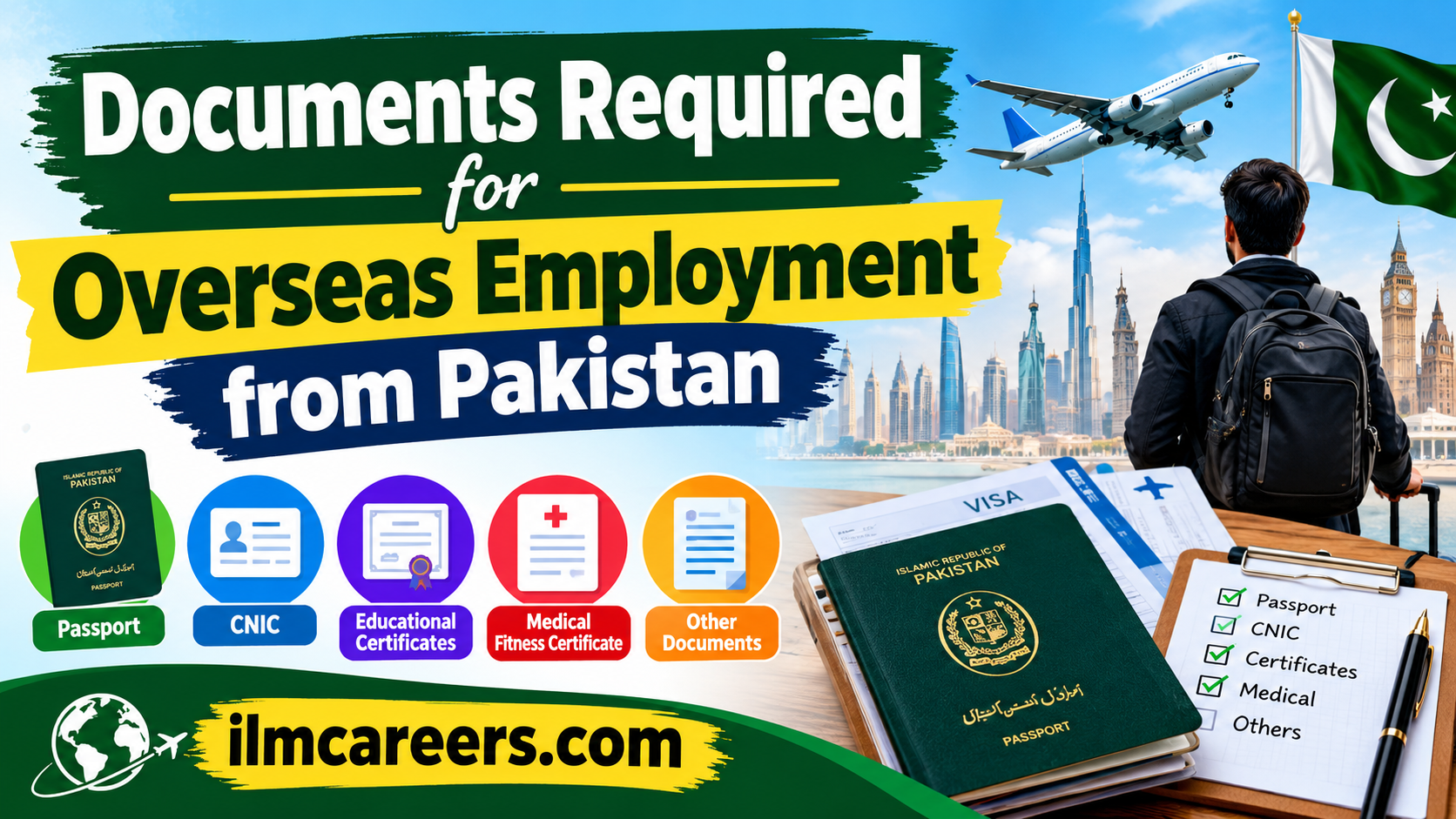
Getting a job abroad is an important step toward building a better future. Many Pakistani workers travel to countries such as Saudi Arabia, the United Arab Emirates (UAE), Qatar, Oman, Bahrain, Kuwait, and other destinations to find employment opportunities.
However, before leaving Pakistan for a foreign job, applicants need to prepare the required documents. These may include a valid passport, CNIC, employment contract, work visa, medical fitness certificate, and Protector of Emigrants clearance.
The exact requirements depend on the destination country, job category, employer, and recruitment process. This guide explains the essential documents Pakistani applicants may need when preparing for overseas employment.
1. Valid Pakistani Passport
A valid passport is one of the most important documents required for overseas employment. It establishes your identity and allows you to travel internationally.
Before applying for a foreign job, make sure your passport is valid and has sufficient validity for the destination country’s visa requirements.
Important points:
- Carry your original passport.
- Keep photocopies of the passport’s information page.
- Check the expiry date before applying for a work visa.
- Ensure your personal information is correct.
- Follow the destination country’s passport-validity requirements.
If your passport is expired or close to expiry, check whether you need to renew it before beginning the visa process.
2. Computerized National Identity Card (CNIC)
A valid Computerized National Identity Card (CNIC) is commonly required during overseas employment processing in Pakistan.
The CNIC helps authorities verify your identity and personal information during recruitment and Protector of Emigrants registration.
You should prepare:
- Original CNIC.
- Clear photocopies of both sides.
- Any additional identity documents requested by the relevant authority.
Make sure your name, date of birth, and other details are consistent across your passport, CNIC, and employment documents.
3. Foreign Job Offer Letter or Employment Contract
A job offer letter or employment contract confirms that a foreign employer has offered you a position.
Before accepting an overseas job, carefully review the document to understand your employment conditions.
Your employment contract should clearly state, where applicable:
- Employer or company name.
- Job title and responsibilities.
- Monthly salary and currency.
- Working hours.
- Overtime arrangements.
- Accommodation and transportation benefits.
- Medical insurance or healthcare arrangements.
- Contract duration.
- Leave entitlement.
- Terms and conditions of employment.
Do not sign a contract you do not understand. If the employer or recruitment agent changes the salary or job conditions after selection, request written clarification before proceeding.
For jobs processed through a licensed Overseas Employment Promoter (OEP), additional recruitment documents and official permission details may be required.
4. Valid Work Visa or Employment Permit
A valid work visa or employment authorization is generally required to work legally in another country.
Visa procedures vary by destination. Some employers arrange the initial work authorization, while the applicant must complete additional steps before travelling or after arrival.
Depending on the country, you may need:
- Employment visa or work permit.
- Visa approval or authorization document.
- Employer sponsorship details.
- Visa application reference number.
- Additional immigration documents requested by the relevant authorities.
Important: Do not assume that a visit or tourist visa permits employment. Verify the correct visa category through official immigration channels before travelling.
5. Protector of Emigrants Clearance
Pakistani citizens proceeding abroad for employment generally need to complete the applicable Protector of Emigrants registration and clearance process.
This process records overseas employment details and helps provide protection under Pakistan’s emigration framework.
The Bureau of Emigration and Overseas Employment (BEOE) provides official information about emigrant registration, required documents, and procedures.
Depending on whether you are travelling through a licensed recruitment agency or under direct employment, the documentation may differ.
Documents commonly required for Protector processing include:
- Valid Pakistani passport.
- CNIC.
- Work visa or relevant visa documentation.
- Signed employment contract or Foreign Service Agreement.
- Prescribed fee and welfare-fund payment receipts.
- Insurance documentation.
- Recruitment permission details, where applicable.
- Any additional documents requested for your case.
Applicants should confirm the current checklist and fee structure with the relevant Protectorate of Emigrants office or through the official BEOE website before submitting their application.
Official resource: Bureau of Emigration and Overseas Employment
6. Medical Fitness Certificate
Many overseas employers and destination countries require applicants to undergo a medical examination before a work visa is issued or finalized.
Medical requirements vary according to the destination country, occupation, visa category, and employer.
You may be asked to provide:
- Medical fitness certificate.
- Laboratory test reports.
- Chest X-ray or other examinations, where required.
- Medical examination records from an approved medical centre.
For certain Gulf employment visas, applicants may need to complete medical testing through a designated or approved centre.
Tip: Confirm which medical centre is authorized for your destination country before paying for an examination. A report from an unapproved facility may not be accepted.
7. Passport-Sized Photographs
Passport-sized photographs may be required for visa applications, employment records, medical processing, or other official procedures.
Keep several recent photographs available.
Before taking your photographs, check the destination country’s requirements regarding:
- Photograph size.
- Background colour.
- Face position and visibility.
- Digital image specifications.
- Recency of the photograph.
Different applications may require different formats, so follow the instructions provided by the relevant authority.
8. Educational Certificates and Professional Qualifications
Applicants applying for skilled, technical, professional, or supervisory jobs may need to provide educational certificates and qualification documents.
Examples include:
- Matriculation or intermediate certificates.
- Diplomas and technical certificates.
- University degrees.
- Vocational training certificates.
- Professional licences.
- Trade test results, where applicable.
Some employers or destination-country authorities may require educational documents to be verified or attested by the relevant Pakistani authorities and other designated organizations.
Do not pay for unnecessary attestation. First confirm which documents need attestation for your specific job and destination.
9. Experience Certificates and Previous Employment Records
Experience certificates can strengthen your application and help employers verify your professional background.
They may be particularly useful for applicants seeking employment as electricians, welders, drivers, technicians, engineers, healthcare professionals, supervisors, and skilled construction workers.
An experience certificate should ideally include:
- Your full name.
- Previous employer’s name.
- Job title.
- Employment period.
- Main responsibilities.
- Authorized signature or company stamp, where applicable.
Some employers may also request a previous employment letter, professional reference, or evidence of relevant training.
Always provide genuine documents and ensure that the information matches your CV and application.
10. Police Character Certificate
A police character certificate may be required for certain jobs, visa categories, or destination countries.
It is not a universal requirement for every overseas worker, so applicants should confirm whether it applies to their particular case.
If required, obtain the certificate from the appropriate authority and check whether translation, verification, or attestation is necessary.
Apply early if the employer requests this document, as processing times can vary.
11. Insurance and Welfare-Fund Documents
Insurance and welfare-related documentation may form part of the Protector of Emigrants registration process.
Applicants should retain proof of any required payments and copies of relevant insurance documents.
Depending on the recruitment route, the process may involve:
- Insurance certificate.
- Welfare-fund payment receipt.
- Protector or registration fee receipt.
- Other prescribed payment records.
Always check the latest official fee schedule and payment instructions. Avoid paying unofficial charges to agents or individuals without a valid receipt.
12. Next of Kin and Emergency Contact Information
Some registration, insurance, or employment procedures may require information about a family member or emergency contact.
Prepare accurate details, such as:
- Full name of your next of kin.
- Relationship to you.
- Contact number.
- Address.
- Any supporting identity information specifically requested by the relevant authority.
Keep these details consistent across the forms you submit.
13. Additional Documents for Specific Countries and Jobs
Some occupations and destinations require additional paperwork. These requirements should be checked before the visa process is finalized.
For Saudi Arabia Jobs
Depending on the job and visa category, applicants may need:
- Employment visa documentation.
- Signed employment contract.
- Medical fitness reports.
- Relevant technical or educational qualifications.
- Professional verification or registration for regulated occupations.
- Protector clearance before departure from Pakistan.
Check the current requirements with the Saudi employer and the appropriate official authorities.
For UAE Jobs
Depending on the employer and job category, applicants may need:
- Employment offer or contract.
- Work-permit or employment-entry documentation.
- Passport and photographs.
- Medical fitness procedures required by the UAE.
- Educational or professional documents, where applicable.
- Pakistani emigrant registration and clearance before departure, where required.
Verify the employer and employment offer before paying money or travelling.
For Qatar, Oman, Kuwait, and Bahrain
Requirements vary by country, employer, and occupation. Applicants may need an employment contract, work authorization, medical examination, qualifications, and additional documents requested by immigration or labour authorities.
Do not rely on another applicant’s checklist as proof that the same documents will be sufficient for your case.
Also Read More: Job Opportunities in UAE 2026 Multiple Technical Positions
14. Documents Required for Direct Employment vs. Recruitment Agencies
The documents you need can differ depending on how you obtained the job.
If You Get a Job Through a Recruitment Agency
Applicants may be asked to provide:
- Passport.
- CNIC.
- Work visa or relevant visa documents.
- Employment contract or Foreign Service Agreement.
- Recruitment permission details.
- Insurance and prescribed fee receipts.
- Medical and qualification documents, where applicable.
Use a licensed Overseas Employment Promoter and verify the relevant job permission before proceeding.
If You Get a Job Directly From a Foreign Employer
Applicants may need:
- Valid passport and CNIC.
- Employer’s job offer.
- Signed employment contract or required undertaking.
- Work visa or authorization.
- Supporting medical, qualification, and experience documents.
- Documents and payment receipts required for Protector registration.
The exact checklist should be confirmed with the relevant Protectorate of Emigrants office or the official BEOE online registration service.
15. How to Avoid Overseas Employment Scams
Document preparation is important, but verifying the job is equally essential. Fraudulent recruiters may use fake job offers, misleading visa documents, or false promises of guaranteed employment.
Follow these precautions:
- Verify the recruitment agency: Check the agency’s licence through the official BEOE website.
- Check the job permission: Where applicable, verify the recruitment permission and job details.
- Read the contract: Confirm the salary, job title, employer, and benefits in writing.
- Verify the visa: Use the destination country’s official immigration channels.
- Keep payment receipts: Do not pay unofficial charges without proper documentation.
- Avoid guaranteed-visa claims: Be cautious of anyone promising a guaranteed job or visa in exchange for an unusually large advance payment.
- Never submit fake documents: False certificates, forged contracts, and misleading information can cause serious problems.
- Keep copies: Store digital and printed copies of your passport, contract, visa, receipts, and other important documents.
For official job information and recruitment verification, visit the BEOE website.
16. Final Checklist Before Leaving Pakistan
Use this checklist to prepare for your overseas employment journey.
| Document | Usually Needed? |
|---|---|
| Valid Pakistani passport | Yes |
| CNIC | Yes |
| Job offer or employment contract | Yes |
| Valid work visa or relevant authorization | Yes |
| Protector of Emigrants clearance | Generally required for employment abroad |
| Medical fitness certificate | Depends on country and job |
| Passport-sized photographs | Frequently required |
| Educational certificates | Depends on job |
| Experience certificates | Depends on job |
| Police character certificate | If required |
| Insurance documents | May be required for Protector processing |
| Welfare-fund and prescribed fee receipts | Where applicable |
| Next-of-kin information | Where requested |
| Professional licence or trade certificate | For certain occupations |
Important: This is a general preparation checklist, not a universal official document list. Requirements can change, and some documents may not apply to your situation. Confirm the latest instructions with the destination country’s authorities, your employer, and the relevant Protectorate of Emigrants office.
Frequently Asked Questions
1. What documents are required to work abroad from Pakistan?
Common documents include a valid passport, CNIC, job offer or employment contract, work visa, and applicable Protector of Emigrants clearance. Medical reports, photographs, insurance records, qualifications, and other documents may also be required.
2. Is Protector clearance necessary for overseas employment?
Pakistani citizens proceeding abroad for employment generally need the applicable Protector of Emigrants clearance. Confirm the current process and requirements through BEOE or the relevant Protectorate of Emigrants office.
3. Is a medical certificate required for every overseas job?
Not necessarily. Medical examinations depend on the destination country, visa category, occupation, and employer. Some countries require testing through approved medical centres.
4. Do I need educational certificates for Gulf jobs?
It depends on the position. Employers may request degrees, diplomas, technical certificates, or professional licences, especially for skilled and regulated occupations.
5. Can I travel abroad for a job without a work visa?
You must have the appropriate legal authorization to work in the destination country. A visit or tourist visa should not be treated as permission to work. Check the destination country’s official rules before travelling.
6. Where can I find official overseas job information in Pakistan?
The Bureau of Emigration and Overseas Employment publishes information about foreign jobs, licensed recruitment promoters, and emigrant registration procedures.
Conclusion
Preparing the correct documents is an essential part of finding legal overseas employment from Pakistan. Before travelling, organize your passport, CNIC, job contract, work visa, medical reports, qualifications, and any documents required for Protector of Emigrants clearance.
Most importantly, verify the employer, recruitment agency, and job conditions before making payments or committing to travel. Careful preparation can help you avoid delays, reduce the risk of fraud, and begin your overseas career with greater confidence.
For more overseas job updates, employment guides, and career advice, visit ilmcareers.com.